Making Design and Approvals Simple
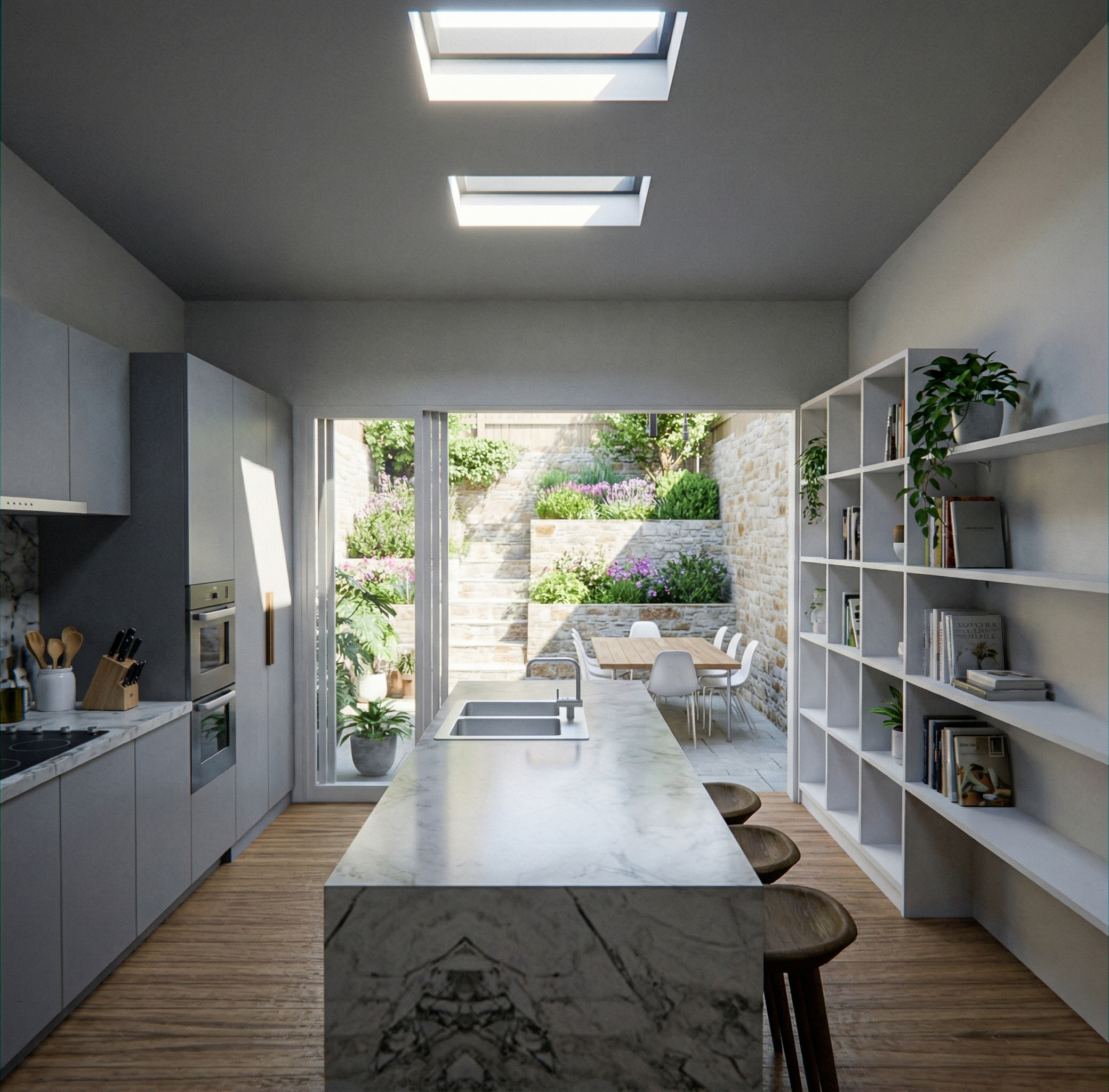
With integrated 3D scanning our services are simpler, faster, more cost effective, more intuitive and more accurate.
Most architectural workflows still begin with 2D measurements, site notes and drawn plans then gradually work up to 3D later.
We flip that.
By capturing your existing home as a precise 3D digital model at the start, we design from reality, not approximation. That means the early design phase becomes more confident and more accurate because you’re not guessing what’s “probably” there. You’re working with what is there.
This isn’t about producing a polished image at the end of the process.
It’s about integrating 3D into the early workflow, so the whole project runs with more clarity from the beginning.
Why the Starting Point Matters in Renovation Design
In residential architecture, most of the risk in a renovation or new build shows up early. Well before construction starts, decisions are made that shape cost, buildability, approvals and timing.
The challenge is: existing homes are rarely as straightforward as they look on paper. Walls aren’t perfectly square, levels don’t always line up, and previous work isn’t always obvious until later.
When design begins with assumptions, clarity takes time. And when clarity comes late, projects slow down with more redesign, more documentation churn, and more second-guessing.
Starting with a scan changes that foundation. It gives the design process a more reliable base and makes the path forward more direct.
From Assumption to Accuracy: What 3D Scanning Enables
When an existing home is captured as a precise 3D digital model, the design conversation shifts immediately.
Instead of working around approximations, we’re working from reality. New architecture can be tested against existing conditions. Spatial ideas can be explored with confidence. Constraints are understood early not discovered mid-way through documentation.
This leads to:
More informed design decisions early
Fewer surprises during documentation
Less rework as the project progresses
For homeowners, that accuracy translates into a calmer experience one where decisions feel grounded, not speculative.
Changing the Way Decisions Get Made: You Can Actually See It
One of the biggest benefits of a 3D-led process is how it changes decision-making.
Traditional plans and sections require imagination. Some clients can easily visualise space from drawings; many can’t and that’s completely normal. Architecture is spatial, and space is hard to understand abstractly.
When you can see your existing home and proposed changes together in 3D, decisions become clearer:
Room proportions make sense
Connections between old and new are obvious
Scale, height and flow can be assessed intuitively
And when decisions are made with clarity, there are fewer late changes which protects both timeline and budget.
Faster to Resolve, Faster to Document, Faster to DA
One of the least talked-about benefits of designing in 3D from day one is its impact on timeframes particularly the journey to Development Application (DA).
DA delays are rarely caused by ambitious design. More often, they come from uncertainty:
Incomplete or assumed existing conditions
Unresolved spatial or compliance questions
Inconsistencies across drawings and reports
A 3D-scanned starting point reduces these issues because the information is accurate from the outset. Design questions get answered earlier, documentation becomes more consistent, and the intent is clearer to everyone involved including councils.
In practice, this can shorten the path to DA by two to three months not because anything is rushed, but because the workflow is more direct.
Unable to load the shape
One Model. One Workflow. Better Integration.
Another advantage of working in 3D from the beginning is continuity.
When one accurate model underpins early design, refinement and documentation, information doesn’t fragment as the project progresses. Instead of recreating drawings or reinterpreting site conditions at each stage, the project builds from a single source of truth.
That leads to:
Fewer conflicting drawings
Less redundant work
Fewer late-stage corrections
For renovations where existing conditions matter this is a major upgrade in both process and outcome.
Unable to load the shape.
Is Designing in 3D Right for Every Renovation?
Not every project needs this level of precision.
But for major renovations and new builds where complexity is real and decisions carry cost the benefits are tangible.
If your renovation values:
Clear understanding early
Confident decision-making
A smoother, quicker path to DA
Fewer surprises during construction
…then a 3D-led process from day one can genuinely reshape the experience.
If you’d like to explore your renovation in 3D from day one, you can book a 3D design consultation or get in touch to talk it through.